Overview
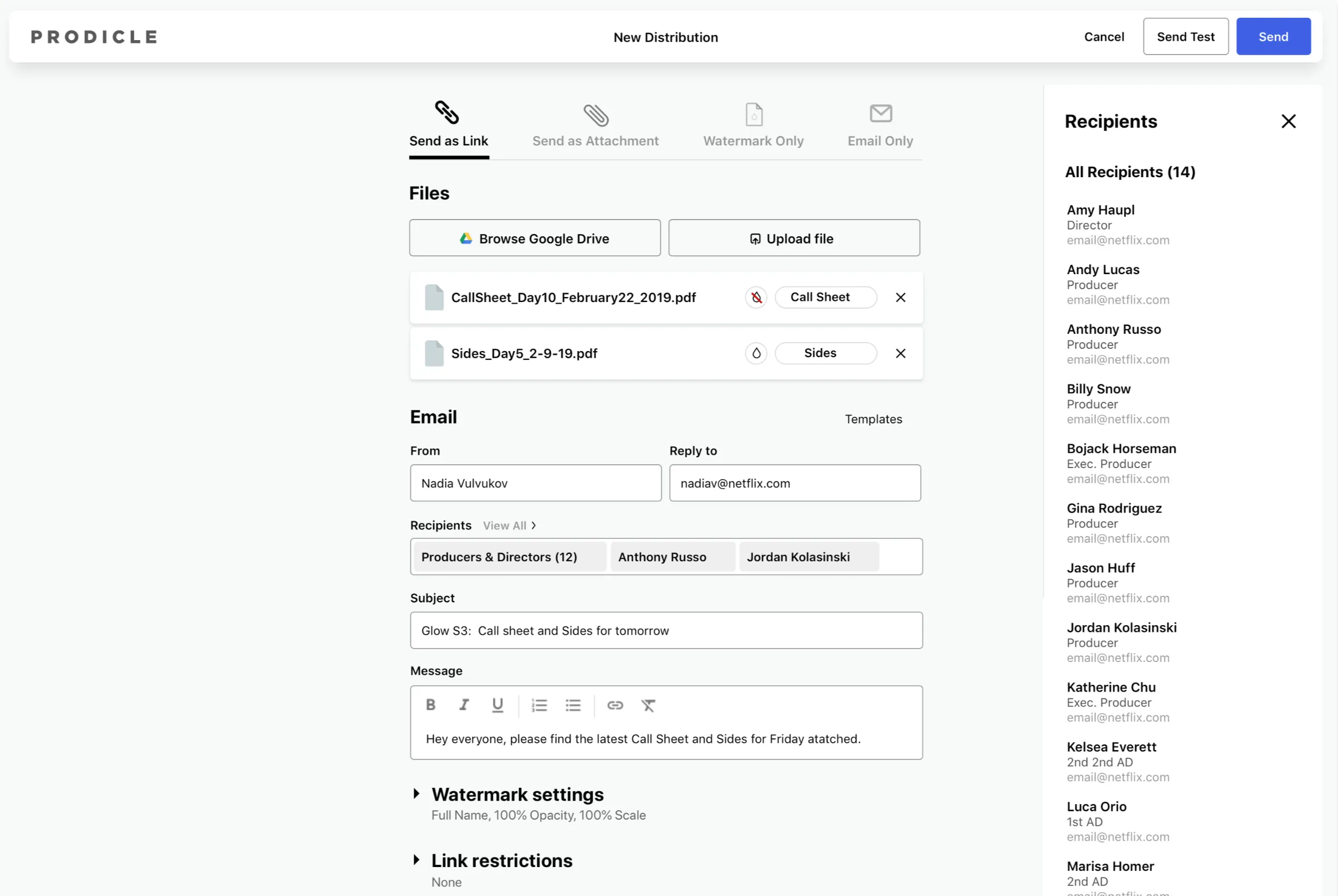
Prodicle Distribution is part of Netflix's production toolkit. It lets a production office coordinator send sensitive documents like scripts to the cast and crew who need them, as attachments or links, while keeping every copy secure and individually traceable. It was one of just two applications Netflix classified as "critical."
I inherited Distribution alongside one other engineer, and after that engineer departed I became its team lead: the person responsible for keeping a critical application healthy while pushing it forward.
The problem
For decades the industry moved scripts around by hand: fax, scan, USB drive, re-upload. The process was slow, impossible to audit, and constantly leaking confidential material. Distribution existed to fix that, but when we took it over it was struggling. We were getting pinged 5 to 10 times a day or more with support issues, and because it was a critical app, those fires routinely ate into nights and weekends.
"Before Distribution, scripts moved by fax, USB drive, and personal email. It was slow, impossible to audit, and things leaked constantly."
The turnaround
Over the next year I went deep on bug-fixing, performance tuning, and refactoring, basically rebuilding the application's health from the ground up:
- Moved the app off legacy cron jobs and synchronous processing onto Sidekiq, shifting heavy workflows to run asynchronously. Some jobs dropped from over 20 minutes to 1 or 2.
- Raised test coverage from roughly 15% to over 90%
- Migrated websocket endpoints from ActionCable to Pusher, aligning with Netflix's "paved road" infrastructure standards.
- Dove headfirst into learning some Python to extend the watermarking engine, adding configurable positioning, sizing algorithms, and other customizations that gave productions finer control over how their documents were marked.
The payoff was dramatic. Support volume fell so far that some weeks passed with a single issue, and eventually weeks with none at all.
The product and the hard part
What makes Distribution both powerful and demanding is per-recipient watermarking. Every recipient gets their own uniquely marked copy, so any leaked document traces straight back to its source. That multiplies the work fast. A job of ten files going to twenty people isn't twenty sends; it's two hundred uniquely watermarked documents, each with its own optional secure, expiring link.
Real productions run far bigger and send in bursts. A new draft drops and the whole unit needs it at once. Keeping that generation-and-delivery pipeline fast and reliable under spiky, high-volume load was the core engineering challenge.
Impact
Distribution went from a constant source of fire-fighting to something the team could actually rely on. No more nights and weekends chasing down failures.
Stack
Core technologies on this project: